Showing posts with label HALE. Show all posts

Tuesday, December 7, 2010

High altitude flight Re, new airfoil KS415/14.3

The Reynolds number at very high altitude is very low. Here is an article about airfoil study for 60000 ft altitude flight. My previous airfoils are not very suitable in a small aircraft at 60000 ft, they require longer chord to be efficient. I made series of new airfoils for short chord and high altitude and ended up with the KS415/14.3.

Example:
altitude = 20000 m
velocity = 80 m/s
wing chord = 0.8 m (80 cm)
=>
Re = 396331.94
M = 0.2711

Therefore it is beneficial that the airfoil used in this kind of aircraft is such that provides maximum L/D at low Re, here around 400000.

Here are some simulations:


Then some airfoils that I created:
http://www.katix.org/karoliina/airfoils/KS414.dat
http://www.katix.org/karoliina/airfoils/KS415%2014.3.dat
http://www.katix.org/karoliina/airfoils/KS416%2014.20.dat

KS416:

More simulation at low Re, two conditions: 80 m/s at 600000 ft and 111 m/s (400 km/h) at 60000 ft:

Added case 154 m/2 (300 kts) at 60000 ft:

Of these, the KS415 exhibits the lowest drag. Here is the geometry of the KS415:


Here is a smoothed version of KS415/14.3:
http://www.katix.org/karoliina/airfoils/KS415_14_3sm.dat

And simulation for a Reynolds number range:

Sunday, February 28, 2010

Airplane design from structural efficiency point of view combined with aerodynamics point of view - multi-domain optimization

So far I have been looking only the aerodynamics side, but it is quite evident that compromises are needed on the aerodynamics side to achieve the best structural efficiency. I think one good example is Virgin Global Flyer (Scaled Composites model 311). I have not analysed yet the structure, but common sense says that trimaran has weight placed more evenly along the wing span avoiding a very large point load in the middle where the single fuselage would normally exist. The trimaran may have more wetted area than a single fuselage, but on the other hand, weight savings in the very high aspect ratio wing and space gains for the extra fuel are in this concept very important factors.

I find the trimaran configuration quite interesting - several different engine placement configurations for example can be used with this configuration without changing the aerodynamic shape of the concept very much. It is also interesting because it allows placement of the main gear away from the center fuselage and thus provides greater stability on the ground when the aspect ratio is high even if there is fuel placed to the wings very far away from the center of gravity. And as can be seen the same design suits several different missions: Global Flyer is very much like White Knight 2 with SpaceShipTwo under it on the center. Almost the same configuration, adapted to different kind of mission for very different kind of parameters (Global Flyer = long range cruise, White Knight 2 = optimized for climb).

Global flyer drawing Google found from some site
Wikipedia has another great photo, this is from front

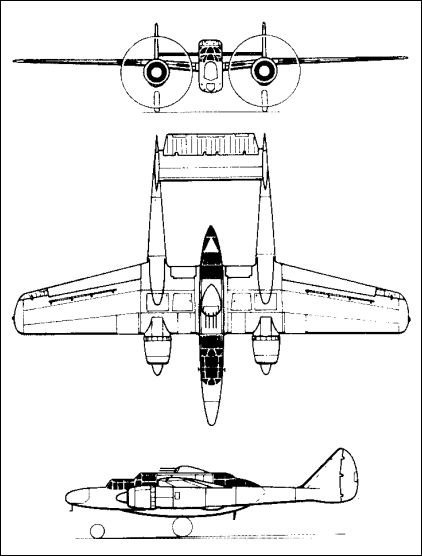
The configuration is not really so new and not so unproven either, as people might expect, here is one example where a similar configuration has been used a long time ago:
Northrop Widow
The only difference here is that the Northrop Widow was optimized for different mission than either of the abovementioned and that it had piston engines in front of the outer "fuselages" which were interconnected from the tail section similarly than in Adam A500 whereas the Global Flyer and White Knight Two have two separate tails. It is quite apparent why the tails are separate in these aircraft - because the outer fuselages are placed so widely apart from each other, connecting the tails would have made the tail unnecessarily large which would have caused negative effect for the drag despite it would have had fewer intersections. On the other hand, I have been looking different HALE concepts, and it is quite apparent that the number of intersections is not the major drag source in high altitude aircraft, but the induced drag is, and to minimize induced drag, more intersections can be allowed as the penalty from them is lesser than limiting the aspect ratio would be. This is why there are even some concepts considered at the moment which have wing struts - even if everybody knows that they produce drag, in some concepts, the significance of that drag can be proportionally small whereas the increased aspect ratio has major effect on minimizing the total drag of the aircraft. HALE aircraft have to be quite different than those which are designed to cruise at low altitude, the drag percentages of each contributors are quite different and "one size does not fit all".

It is quite interesting area to explore when the structural efficiency is added to the equation in addition to the aerodynamics and the result is a compromise on both structures and aerodynamics instead of being optimized for either aerodynamics or for structures. The mission parameters tend to heavily affect both and best suited results can be achieved by combining these two and by knowing the intended use exactly, potentially bigger gains can be realized than in a concept that is a general purpose in everything (GA = GENERAL aviation).

Saturday, January 10, 2009

60000 feet with Rotax 912, 80 hp

Here is an article which includes some text about Burt Rutan's Raptor UAV.
www.flightglobal.com/pdfarchive/view/1993/1993%20-%202623.html

Just accidentally when searching about Raptor UAV (this is off-topic to this posting, but anyhow contains interesting information including patent numbers), I found this: Burt Rutan's CV. Needless to say "Burt Rutan is my hero", but here is the CV of Mr. Rutan:

http://www.roycecarlton.com/speaker/Burt-Rutan-Curriculum-Vitae/

Wednesday, November 26, 2008

Three turbos in Subaru EJ22

Hey watch this out:
http://www.youtube.com/watch?v=bU2elPTJyqA

Pretty interesting system built around the Subaru.

HALE

I have been thinking one idea for better utilizing the HALE concept (HALE = high altitude, long endurance).

Usually nobody flies higher than about 40000 ft. If you look out from a commercial passenger aircraft's window, what you see is blue. You can don't even see clouds very well since you are too high to see them closely and you are too low to see the curvature of the Earth and blackness of space. And the publicly available photography from that altitude is very limited, you don't really get to see even virtually how it looks like up there.

There are some interesting videos about balloon flights to high altitude in Youtube. The balloons go to about 80-100 kilofeets. According to videos, that looks already almost like space. Couple of examples:

Long Trail School High Altitude Balloon at Youtube

Nevada BalloonSat at Youtube

The view is so amazing that I feel it odd that nobody has started to carry people to near space experience with high altitude aircraft. Someone offers MIG-flights, but that is just a ballistic jump there from supersonic flight. Aircraft that can loiter in that altitude would give a whole different experience, it could stay there longer than just minutes.

That kind of aircraft would be impossible someone might say? Not so black and white. There are couple of HALE UAVs around which can go this high. And if you for example look Scaled Composites Proteus which can reach 70000 ft, if you'd replace the telecommunications load from the center section with space grade pressurized passenger cabin, the plane could lift several people at one time to the abovementioned altitude.

According to material I have been seeing from high altitude balloons, it seems like the sky is starting to look like space from about 60000 ft upwards. You need afterburning jet engines to go that high? Not necessarily. Look at for example Burt Rutan's UAV that had twin turbocharged modified Rotax 914 (with fuel injection). It was designed to have positive climb rate at 63000 ft. Seems feasible with piston engines in other words. The company that did the Rotax-conversion for the Scaled Composites UAV, have done triple turbocharged and twin turbocharged versions of the Rotax. The triple turbocharged Rotax is usable to over 80 kft, however, the installation looks really complicated (and the biggest turbo is so huge that must be from a truck).

Friday, November 7, 2008

Scaled Raptor UAV Rotax 912 modification

I found an article about high altitude UAVs, and the Rotax 912 modification for Raptor UAV is mentioned here:
http://www.cre8tivenergy.com/uav.htm
(Quite interesting two stage turbo installation)